Moving to North Texas: 12 Facts About McKinney, Celina, Prosper & the Highway 75 Corridor
North Texas keeps showing up on every list of the most affordable places in America to buy a brand new house. For most people moving here from out of state, that's exactly the appeal. But affordable doesn't mean it's right for you.
I've watched people move to North Texas on the sticker price alone, then they spend the next year finding out that cheap houses don't fix everything. I moved my family here from Northern California just over two years ago, so I've been through this exact relocation myself. What follows are twelve facts you need to know before moving to North Texas, the costs that never show up in the affordability rankings, the commutes that don't match the map in your head, and whether this move actually makes sense for you and your family.
We'll cover McKinney , Celina , Melissa , Anna , Van Alstyne , Prosper , and Frisco , the Highway 75 corridor where most of my clients land. I'll walk through the property tax picture, the MUD and PID charges that can add $400 a month to your payment, the school rezoning happening right now, the year-two tax jump on new construction, and the infrastructure reality of living in the fastest-growing corner of the country. By the end, you'll know which town fits your budget and which commute you're actually signing up for.
Table of Contents
- McKinney: Middle Price Point with Historic Roots
- Celina: Fastest Growth and a Construction Site for Years
- Melissa: 14.5% Growth and Infrastructure Catching Up
- Anna: Lower Price, Longer Commute
- Van Alstyne: Still Small, Still Land Around It
- Prosper: Top of the Price Range with Settled Rhythm
- Frisco: Top Prices and Newer MUD Communities
- Which North Texas Town Fits Your Commute and Budget?
- Conclusion
McKinney: Middle Price Point with Historic Roots
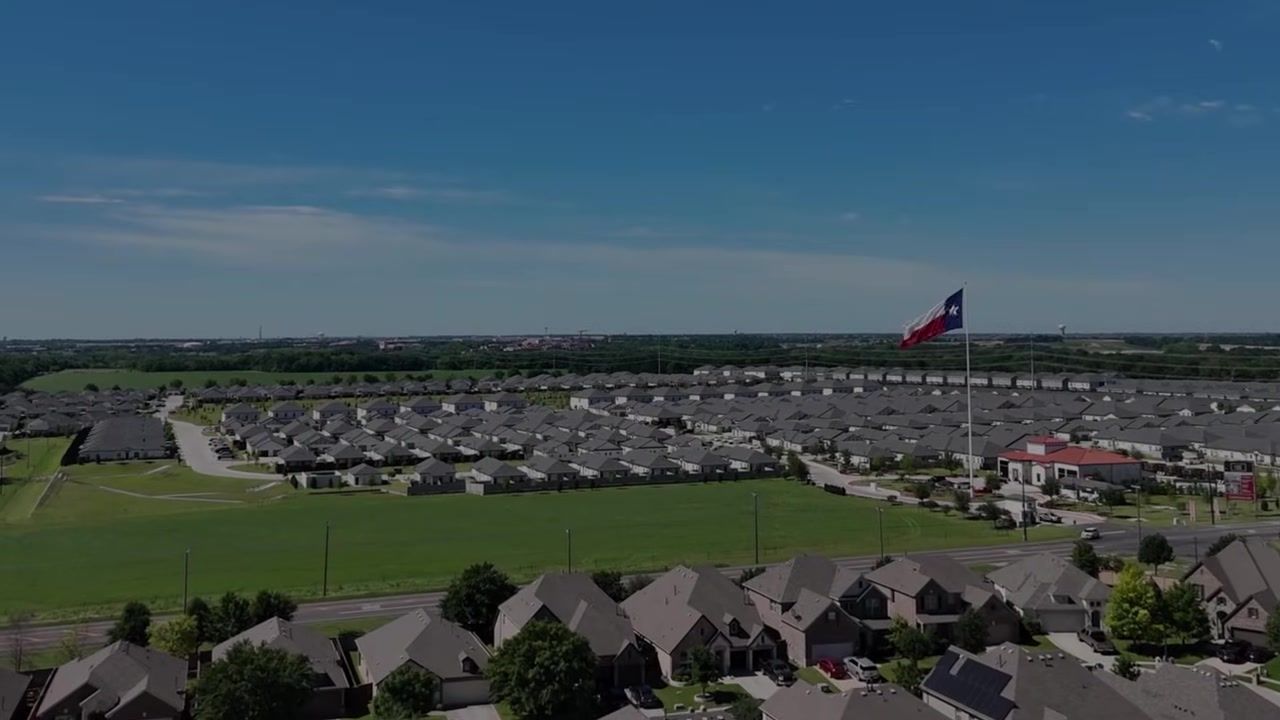
McKinney sits about 30 miles north of downtown Dallas. That's my home base, and it's where most people picture themselves when they search "moving to Dallas." The reality is different. When you pictured yourself grabbing dinner downtown Dallas on a Friday night, that's a real drive both ways on Highway 75 or the Dallas North Tollway, and both of them back up with traffic. That surprises people coming from a city where everything sat inside 20 minutes.
The median sales price in McKinney over the last three months was $505,000, down 3.4% from the same period a year ago, according to Redfin. The average price per square foot came in at $209, down 2% year-over-year. Homes are sitting for 44 days on the market compared to 39 days last year. Zillow has the average McKinney home value at $480,000, down 6% over the past year as of their July 2026 data. So you've got the fastest-growing corner of the country and softening prices all at the same time. That confuses people, but it makes sense when you look around. Builders in this corridor have kept putting houses in the ground, and right now there's more supply than there are buyers ready to sign.
The west side of McKinney is the more developed side now. That's where most of the newer retail and the newer construction sits. The east side is the older side of McKinney, where you'll find the historic downtown square with the courthouse and all the local restaurants and shops. Two different feels, same city, and the price per square foot is not even close. If you want a town with 100 years of history and settled rhythm to it, look hard at McKinney and the area around the historical downtown square. A brand new master-planned community 20 minutes further north is a completely different life, and the price difference is real.
HOA dues in McKinney's master-planned communities typically run $150 to $200 a month. Property taxes are where people really get hit. McKinney's own property tax page uses an average home value of $550,000, total property tax bill of $9,000. That's the whole bill, and the city notes only 23 cents of every dollar you pay actually goes to the city of McKinney. The rest goes to the school district, the county, and the college. Tax Drop puts the combined effective tax rate across Collin County somewhere between 1.7% and 2.3%, depending on exactly where you land. The city just proposed an $880 million budget for the fiscal year 2026-2027. According to The Cooldown, the property tax rate goes to 41 cents per $100 of assessed value, up from 40 cents. It's a small increase on paper, but taxable property value in McKinney is expected to climb by more than $1.5 billion this year. So the rate barely moves and the total pot grows anyways.
If you're coming from California, Washington, or Illinois, you're used to Proposition 13 keeping your assessed value roughly locked. That protection does not exist here. Your value gets looked at every single year. When you run your budget, do not use the number the mortgage calculator spits out on Zillow. Take the tax rate for the exact address, multiply it by the full price, divide by 12. That's the real number. On a $500,000 home, it usually is somewhere between $700 and $900 a month before you've paid a dime of principal.
Schools are another moving target. McKinney ISD's board approved a realignment plan that sets new elementary, middle, and high school attendance boundaries starting in the 2026-2027 school year. That's straight from the district's own announcement in December 2025. The reason is just pure math. Community Impact reported that under the old zones, one McKinney high school was projected to hit nearly 4,300 students by the 2034-2035 school year. The district's other two high schools would stay below 2,200. If schools are driving your purchase, do not take the campus name off a builder's brochure as a promise. Go to the district's own boundary map, confirm the address, and then ask the district directly whether that zone is under review. I do this for clients before we write any offer in specific areas, and I've had it change the house my clients picked.
Celina: Fastest Growth and a Construction Site for Years
Celina was the fastest-growing city in the country last year. It grew 24.6% and added more than 12,000 residents between July 2024 and July 2025. CBS News Texas reported Celina had about 6,000 people in 2010 and more than 64,000 people in 2025. By 2040, Celina is expected to have over 200,000 people. Celina sits about an hour north of downtown Dallas, and that's a real drive on Highway 75 when traffic backs up.
That growth sounds exciting on paper, but being in it is completely different. A Celina realtor told CBS News Texas that people driving around say, "No, we're not ready. The traffic has gotten terrible." The city is still working on catching up with the infrastructure that they haven't caught up with yet. What does this mean for you? It means the dirt lot behind your fence is a framing crew at 6:45 in the morning. It means the grocery store you were promised is a sign on chain-link fence. It means the two-lane farm road you drive to work on gets torn up and widened while you live here.
I walk buyers through brand new sections in Celina every single week. I've watched entire streets go from pastures to occupied in as little as 18 months. Some people love being early and some people hate it. Just know which one you are before you sign. Almost nobody in your new neighborhood is from here. That's not a criticism, it's just the reality of a place that went from 6,000 people to over 64,000 people in 15 years. On my street, the neighbors come from California, Washington, Illinois, New York, Oklahoma, Louisiana. The good side is it's genuinely easy to meet people. Everybody arrived recently, so nobody has a close circle from high school. Somebody knocks on your door with a plate of something your first two weeks of living here. The neighborhood group chat is active before the sod is even down in your front yard.
But the hard side is that there's no built-in support system. Back home, you had parents 20 minutes away on a Tuesday night to babysit. Out here, you don't. Every trip back to see family is a flight out of DFW or Love Field and a chunk of your vacation days. That's the thing my clients underestimate the most, and it usually hits them around month 8 to month 12.
Newer communities in Celina often carry MUD or PID taxes. A MUD is a Municipal Utility District. A PID is a Public Improvement District. In plain English, when a developer builds roads, water lines, and sewer out in a field, somebody has to pay for that infrastructure. Instead of the city funding it, they create a district and the homeowners inside it pay it back through an extra charge on their tax bill. A DFW New Construction Guide updated in August 2026 lays out the real cost. MUD taxes add about $2,000 to $7,000 or more per year on top of your regular city, county, and school taxes, and they typically last for 20 to 30 years. On a $500,000 home, a $5,000 a year MUD or PID works out to $417 a month. That same source points out it's equivalent to financing an extra $67,000 of house for nothing you can see or touch. This is the thing I check on every single property before my clients write an offer, and it's the thing that decides which of these towns actually fits your budget.
Melissa: 14.5% Growth and Infrastructure Catching Up
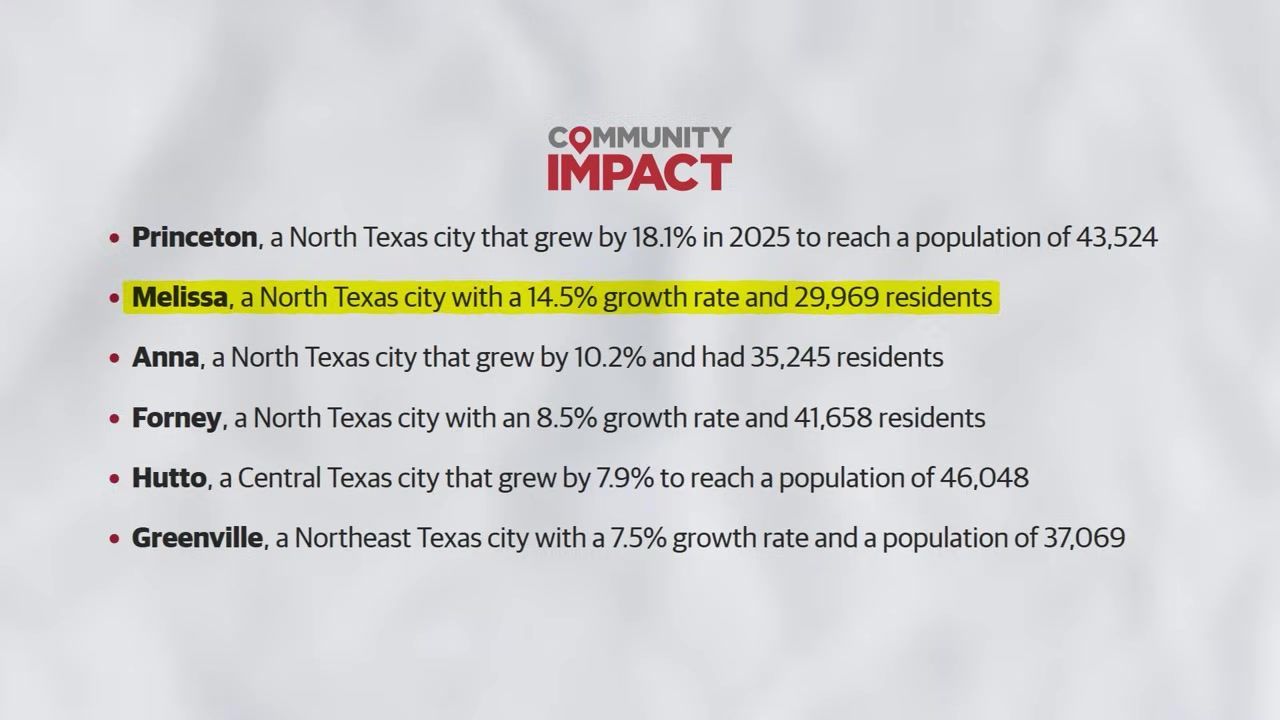
Melissa sits north of McKinney along the Highway 75 corridor. Community Impact reported Melissa grew 14.5% to 29,000 residents. That makes it one of the three fastest-growing cities in America in this corridor that I sell in every week. Like Celina, you're buying into a construction site and you might be living in one for the next five or more years. The infrastructure is catching up, but it hasn't caught up yet.
Every 10 to 15 minutes you're willing to drive north, you buy back roughly $50,000 to $75,000 of house at the same monthly payment. That's the real trade in this market. Melissa sits in the middle of that trade. You're further from downtown Dallas than McKinney, closer than Anna or Van Alstyne. The question isn't whether the town is the best, it's how much of your week you're willing to spend in the car to get the price per square foot you want. That decision follows you for years.
Check for MUD or PID taxes in newer Melissa communities. Two identical houses, same builder, same exact floor plan, two streets apart, one costs $400 a month more to own. Nothing about the house explains it. The difference is a MUD or PID tax. A MUD is not automatically bad. It's often what makes a brand new $300,000 house possible out here at all. But you need to know it's there, you have to know the rate, and you have to know how many years are left on it before you sign anything. It's not on Zillow, it's not on the builder's flyer. If nobody pulls it for you before you sign, you find out on your first full tax bill, and by then you own the home.
From our own findings in June 2026, buyers who budget only for mortgage principal and interest routinely miss 30 to 40% of their actual monthly housing costs in Texas MUD and PID communities. Think about what that means. You get quoted a payment of $2,100 and your real number is closer to $2,900 a month. A $300,000 home in one of these districts typically carries $7,500 to $9,000 a year in property taxes plus $150 to $200 a month in HOA dues. Move up to the $500,000 range and you're looking at $12,000 to $15,000 a year in taxes plus that HOA. That's especially true in a master-planned community with a massive lagoon or a resort pool attached to it. Somebody has to pay for that lagoon. Somebody has to pay for that amenity center. It's you every single month for as long as you own that home in that community.
Anna: Lower Price, Longer Commute
Anna sits further north from Celina along Highway 75. Community Impact reported Anna grew 10.2% to 35,000 residents, making it one of the three fastest-growing cities in America in this corridor. A house in Anna might save you $60,000 compared to one in Prosper, but if your office is in Richardson, you just bought yourself an extra 30 to 40 minutes each day, five days a week.
I tell every single client the same thing: before you fall in love with the subdivision, open your map app and run the drive from that address to your office at 7:30 on a Tuesday morning, not at noon, not on a Sunday when you're out here visiting model homes. Do that one exercise and you'll cut half the towns off your list right away. Out here, you're not choosing a neighborhood, you're choosing a commute. Every 10 to 15 minutes you're willing to drive north, you buy back roughly $50,000 to $75,000 of house at the same monthly payment. Anna sits on the lower end of the price range in this corridor, but the commute is real.
Like Celina and Melissa, Anna is a construction site environment. The infrastructure is catching up. Check for MUD or PID taxes in newer communities. That MUD or PID tax is the difference between a house you can comfortably afford and the one that costs you $400 a month more than you planned for the next 25 to 30 years. Our own research found that buyers who rely on the builder's estimated taxes in marketing materials typically underestimate their actual first full-year tax bill by $2,000 to $4,000. The upgrades that hold value and the ones that don't are not the ones the rep pushes. That's a conversation worth having before you spend $30,000 in that showroom.
Van Alstyne: Still Small, Still Land Around It
Van Alstyne sits further north from Anna along Highway 75. It's still small and there's still land around it. Every 10 to 15 minutes you're willing to drive north, you buy back roughly $50,000 to $75,000 of house at the same monthly payment. Van Alstyne is at the far end of that trade. You're an hour or more from downtown Dallas, but the price per square foot reflects it.
Check for MUD or PID taxes in newer communities. The same rules apply. A $5,000 a year MUD or PID works out to $417 a month on top of your regular taxes and HOA. That's equivalent to financing an extra $67,000 of house for nothing you can see or touch. If you're looking at Van Alstyne or anywhere in this corridor, get a real insurance quote on the specific address during your option period, not after closing. Ask two questions: How old is the roof? And what is my wind and hail deductible? Those two answers will move your monthly payment more than negotiating $5,000 off the sales price.
The Dallas Morning News reported in May 2026 that frequent North Texas hailstorms have caused billions in damage and are pushing Dallas-Fort Worth home insurance premiums higher. For the statewide picture, the average annual cost of home insurance in Texas was $4,300 in 2024, up 14% from the year before. Insurify projects another 3% average increase across the state in 2026. If you're moving from a market where you paid $1,000 a year, that's a jump of a few hundred dollars a month once it's rolled into escrow. Roofs in this part of the state take an absolute beating from our weather. Claims history follows the property. Deductibles on wind and hail are often structured differently than the rest of your policy, so read that page very carefully.
Prosper: Top of the Price Range with Settled Rhythm
Prosper sits between McKinney and Frisco. It's at the top of the price range with Frisco. If you want a town with 100 years of history and settled rhythm to it, look hard at Prosper. It's a different life than a brand new master-planned community 20 minutes further north, and the price difference is real.
Prosper ISD went from a projected $12 million surplus to a $29 million shortfall for the 2025-2026 school year, and it pushed back the opening of a new middle school by a year. This was covered in October 2025 by the Community Impact Report. None of that is a knock on the district. It's a great school district. It's what happens when you add tens of thousands of people faster than you can pour the concrete. But it matters for you. If schools are driving your purchase, do not take the campus name off a builder's brochure as a promise. Go to the district's own boundary map, confirm the address, and then ask the district directly whether that zone is under review.
Check for MUD or PID taxes in newer Prosper communities. The DFW New Construction Guide updated in August 2026 names the exact places to check: Prosper, Celina, Melissa, Anna, and newer Frisco communities. Those are the towns I sell in weekly and see this happen weekly. A MUD is not automatically bad, but you need to know it's there. You have to know the rate, and you have to know how many years are left on it before you sign anything. This is the thing I check on every single property before my clients write an offer, and it's the thing that decides which of these towns actually fits your budget.
Frisco: Top Prices and Newer MUD Communities
Frisco sits south of Prosper. It's at the top of the price range with Prosper. Newer Frisco communities may have MUD or PID taxes. The same rules apply. Two identical houses, same builder, same exact floor plan, two streets apart, one costs $400 a month more to own. Nothing about the house explains it. The difference is a MUD or PID tax.
Check the district boundary map. Schools are a moving target across this corridor. McKinney ISD, Prosper ISD, and Frisco ISD are all managing growth faster than they can pour the concrete. If schools are driving your purchase, confirm the address on the district's own boundary map and ask the district directly whether that zone is under review. I do this for clients before we write any offer in specific areas, and I've had it change the house my clients picked.
Most of what sells in this corridor is new construction, and that's what brings a lot of buyers to the state. McKinney, Melissa, Celina, Anna, Prosper, and Frisco are all full of it. The number one thing to know is this: take your own agent with you the very first time you walk into the model home and have them register you at the door. If you tour alone and give them your information, you can lose the ability to bring your own representation on that community later on when you do get represented. It costs nothing to bring an agent to that model home. It can cost you a lot if you don't. The friendly person who greets you at the model home does not work for or represent you. That's not me being cynical. It's the job. The builder sales rep is paid by the builder and represents the builder's interest in that transaction. They're often great at their job. They're just not on your side of the table.
Your property tax bill in year two can be 40 to 60% higher than year one, and you did nothing wrong. Here's why: If your house wasn't finished by January first, the county only taxed the land, an empty lot. So your first tax bill is small and your first year of mortgage payment is built around that small number. What I make sure to do with all my buyers that are purchasing new construction is to review their first year payments based on what their taxes are going to be on that land value. Then the appraisal district comes back the following January and puts the finished house on the rolls. Now they're taxing the entire thing. LRG Realty documents that exact jump at 40 to 60% in their June 2026 breakdown of Texas new build taxes. You don't get a phone call about it. You get a letter from your mortgage servicer saying your escrow account is short, and it is shocking, and your monthly payment is going up, sometimes by $400 or $500 a month on a house you've owned for only 14 months. This is the single most common shock I hear about from people who bought new construction here in North Texas without anyone explaining it to them. The fix is easy if you know it's coming. Ask your lender to escrow based on the full finished value of the home, not the land-only value. Yes, your real payment starts higher, but it's your real payment and you never get that shocking letter in the mail.
Which North Texas Town Fits Your Commute and Budget?
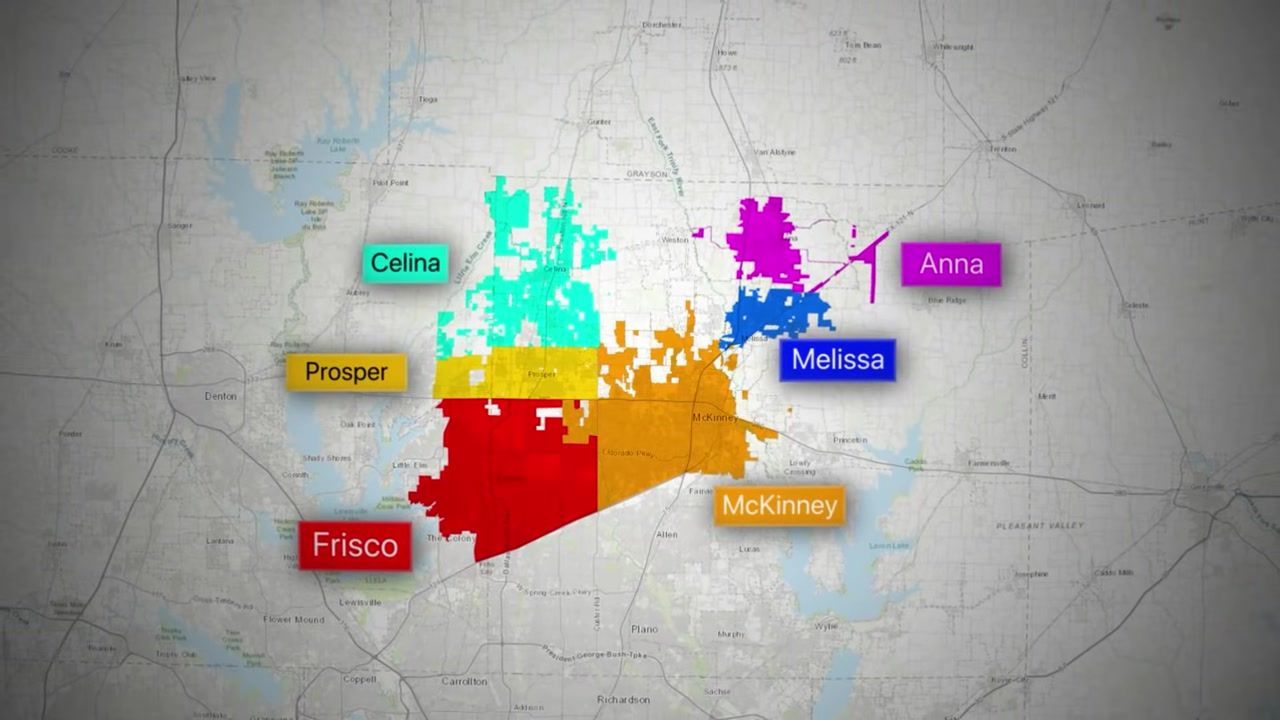
People treat North Texas like it's one big place. It really isn't, and the differences show up in your budget fast. When you ladder heading north, Frisco and Prosper sit at the top of the price range. McKinney sits right in the middle. Melissa at 29,000 residents and Anna at 35,000 per Community Impact sit lower. Keep going up Highway 75 and you hit Van Alstyne and Sherman, and they're still small with still land around them.
Here's the practical version: every 10 to 15 minutes you're willing to drive north, you buy back roughly $50,000 to $75,000 of house at the same monthly payment. That's the real trade in this market. The question isn't whether the town is the best, it's how much of your week you're willing to spend in the car to get the price per square foot you want. That decision follows you for years.
Choose McKinney if you want the middle price point, a historic downtown square, and a settled rhythm. You're 30 miles north of downtown Dallas, property taxes run $9,000 a year on a $550,000 home, and school zones are under realignment starting 2026-2027.
Choose Celina, Melissa, or Anna if you're willing to drive further north to buy back $50,000 to $75,000 of house. You're living in a construction site for the next five or more years. The grocery store you were promised is a sign on chain-link fence. The two-lane farm road you drive to work on gets torn up and widened while you live here. Check for MUD or PID taxes in newer communities.
Choose Prosper or Frisco if you want the top of the price range and a settled rhythm. Check for MUD or PID taxes in newer communities. Check the district boundary map. Schools are a moving target.
Choose Van Alstyne if you want small, land around it, and the lowest price per square foot. You're an hour or more from downtown Dallas. Check for MUD or PID taxes in newer communities.
Never compare two houses on just price. Compare them on the total monthly number. That total monthly number is different in every single one of these towns, and it changes street by street inside the same city. Get that wrong and you don't find out for a year. You find out when your mortgage company sends you an escrow shortage letter and your payment jumps $400 a month with no warning.
Conclusion
North Texas keeps showing up on every list of the most affordable places in America to buy a brand new house. For most people moving here from out of state, that's exactly the appeal. But affordable doesn't mean it's right for you. I've watched people move to North Texas on the sticker price alone, then they spend the next year finding out that cheap houses don't fix everything.
The sticker price is the easy part. The bill that comes every January is where people really get hit. Texas has no state income tax. You've heard that 100 times. Nobody tells you where the state gets the money instead. Your value gets looked at every single year. When you run your budget, do not use the number the mortgage calculator spits out on Zillow. Take the tax rate for the exact address, multiply it by the full price, divide by 12. That's the real number. On a $500,000 home, it usually is somewhere between $700 and $900 a month before you've paid a dime of principal.
A cheap house in Texas is not the same as a cheap monthly payment. Buyers who budget only for mortgage principal and interest routinely miss 30 to 40% of their actual monthly housing costs in Texas MUD and PID communities. That MUD or PID tax is the difference between a house you can comfortably afford and the one that costs you $400 a month more than you planned for the next 25 to 30 years. It's not on Zillow, it's not on the builder's flyer. If nobody pulls it for you before you sign, you find out on your first full tax bill, and by then you own the home.
If you're looking at McKinney, Melissa, Celina, Van Alstyne, Anna, Prosper, Frisco, or anywhere here in North Texas, call or text me at 214-326-2323. I'll run the full monthly number on any address you're considering, MUD and PID taxes included, and tell you straight whether that town fits your budget. I made this move from California myself, so I've been on the same side as you.
FAQ
What is the median home price in McKinney?
The median sales price in McKinney over the last three months was $505,000, down 3.4% from the same period a year ago according to Redfin. Zillow has the average McKinney home value at $480,000, down 6% over the past year as of their July 2026 data. Homes are sitting for 44 days on the market compared to 39 days last year.
How much are property taxes in North Texas?
Tax Drop puts the combined effective tax rate across Collin County somewhere between 1.7% and 2.3%, depending on exactly where you land. McKinney's own property tax page uses an average home value of $550,000, total property tax bill of $9,000. On a $500,000 home, it usually is somewhere between $700 and $900 a month in taxes alone before you've paid a dime of principal. Your value gets looked at every single year, unlike California's Proposition 13 protection.
What are MUD and PID taxes?
A MUD is a Municipal Utility District. A PID is a Public Improvement District. When a developer builds roads, water lines, and sewer out in a field, somebody has to pay for that infrastructure. Instead of the city funding it, they create a district and the homeowners inside it pay it back through an extra charge on their tax bill. MUD taxes add about $2,000 to $7,000 or more per year on top of your regular city, county, and school taxes, and they typically last for 20 to 30 years. On a $500,000 home, a $5,000 a year MUD or PID works out to $417 a month.
Why does my property tax bill jump in year two on new construction?
If your house wasn't finished by January first, the county only taxed the land, an empty lot. So your first tax bill is small and your first year of mortgage payment is built around that small number. Then the appraisal district comes back the following January and puts the finished house on the rolls. Now they're taxing the entire thing. LRG Realty documents that exact jump at 40 to 60% in their June 2026 breakdown of Texas new build taxes. Ask your lender to escrow based on the full finished value of the home, not the land-only value.
How much is homeowner's insurance in North Texas?
The average annual cost of home insurance in Texas was $4,300 in 2024, up 14% from the year before. Insurify projects another 3% average increase across the state in 2026. Frequent North Texas hailstorms have caused billions in damage and are pushing Dallas-Fort Worth home insurance premiums higher. Get a real insurance quote on the specific address during your option period, not after closing. Ask how old the roof is and what your wind and hail deductible is.
Should I bring my own real estate agent to a new construction model home?
Yes. Take your own agent with you the very first time you walk into the model home and have them register you at the door. If you tour alone and give them your information, you can lose the ability to bring your own representation on that community later on when you do get represented. It costs nothing to bring an agent to that model home. The builder sales rep is paid by the builder and represents the builder's interest in that transaction. They're often great at their job. They're just not on your side of the table.
Connor Hornsby - North Texas Living
Connor Hornsby, CEO of North Texas Living. With nearly a decade in real estate, I guide buyers, sellers, and investors across North Texas with a client-first focus. Let’s achieve your property goals.

Recent Posts


North Texas Suburbs Buyers Regret: Frisco, Prosper, Melissa, McKinney, Celina & Van Alstyne Compared